


IT Consulting & Infrastructure

We help you plan technology investments the right way. We analyse your current systems and processes and set out a clear roadmap of which software and infrastructure to invest in, and when. Then we build your server, network and security infrastructure and run it as your single point of contact.

Who is it for?

  • Businesses investing in technology without a plan and not seeing results
  • Managers who want an independent view before choosing an ERP, CRM or new software
  • Organisations renewing servers, network and security
  • Companies without an in-house IT team, or whose team needs backup
IT Consulting & Infrastructure

What we do

IT strategy & digital transformation

Current-state analysis, priorities and a step-by-step digital transformation roadmap that fits your budget.

Software & ERP selection

Requirements analysis, vendor comparison and choosing the right ERP, CRM or industry software, plus managing the migration.

Process analysis & improvement

We review your processes on site and report bottlenecks, repetitive work and automation opportunities.

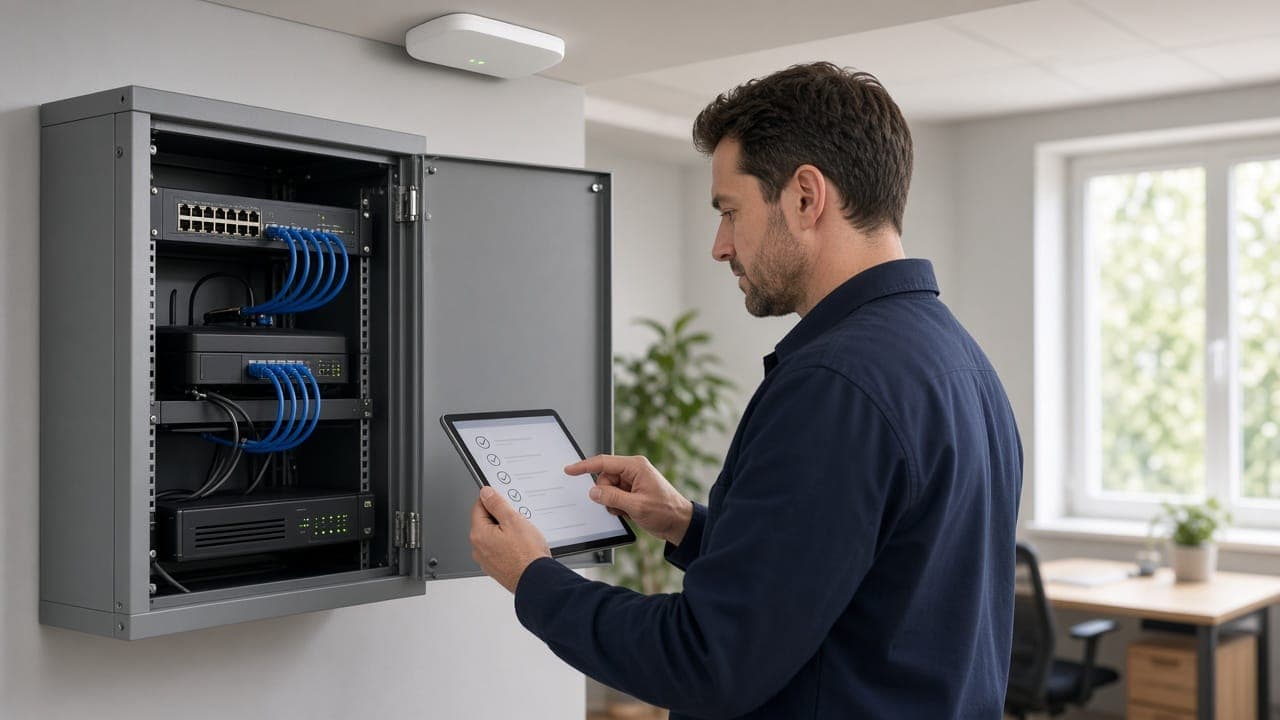
Servers & system rooms

System room design, HP/DELL server setup, Active Directory and mail server configuration.

Cybersecurity & backup

Firewalls, vulnerability scanning, backup and disaster recovery planning.

Network & Wi-Fi

Structured cabling, switching and seamless Wi-Fi, secure VPN links between branches and network monitoring.

Managed IT support

On-site and remote support, scheduled maintenance, and IT plus software under one contract.

What you get

  • IT current-state and risk report
  • Prioritised digital transformation roadmap
  • Design, installation and security/backup plan
  • Monthly maintenance, support and advisory agreement
In-depth guide

A practical guide to IT consulting and business infrastructure

What IT consulting is and when it makes sense

IT consulting is an independent assessment that helps a business plan its technology spending in line with its goals. The point isn’t to sell new hardware; it’s to establish what is genuinely needed, in what order and on what budget.

It tends to pay off fastest for businesses without an in-house IT team, those whose systems have grown piecemeal over the years, those where nobody is quite sure who holds which password, and those that have already lost data after a failure.

The building blocks of business IT

A small or mid-sized company’s infrastructure is made up of several layers that depend on one another. A weakness in one layer undermines the investment in the others, so they’re best assessed together rather than in isolation.

  • Network: structured cabling, switches, wireless access points, firewall and VPN links between sites
  • Servers: file sharing, user management (Active Directory), ERP and application servers
  • Cloud productivity: email, calendars and document sharing on Microsoft 365 or Google Workspace
  • Backup and disaster recovery: copies of your data, retention periods and a recovery plan
  • Licensing: correct, legal use of operating system, office, database and security software licences
  • Endpoint security: patching, antivirus or EDR, and device management on every computer

Criteria for making the right calls

Whether to keep servers on site or move to cloud services depends on how reliable your internet connection is, how cloud-ready your applications are, any data retention requirements and the capacity of your own team. For most businesses a mix of the two gives the most balanced result.

For backup, the widely accepted approach is to keep several copies of your data on different media, with at least one held off site. Testing restores regularly matters as much as having the backup at all. If you use Microsoft 365 or Google Workspace, check whether that data is backed up separately too.

What affects cost and timeline

Infrastructure costs are shaped by the number of users and devices, the number of sites, the state of the building’s cabling, how much existing hardware can be reused and the licences required. The higher your uptime expectations, the more you’ll need extras such as redundant hardware and power protection.

For support contracts, the price depends on guaranteed response times, how much on-site work is needed, the number of devices covered and whether you need cover outside office hours. A clearly written scope puts an end to arguments about what is and isn’t included.

Common mistakes

A good share of infrastructure problems stem from a lack of housekeeping rather than technology itself. These are the mistakes we see again and again, regardless of company size.

  • Assuming backups work without ever testing a restore
  • Leaving admin passwords and network details in one person’s head
  • Running a business network on consumer-grade routers and access points
  • Putting off updates and licence renewals
  • Not enabling multi-factor authentication on email accounts

How fountr approaches it

We begin with an assessment of your current systems, risks and business priorities, then prepare a phased roadmap that fits your budget. Once everything is in place we can keep it running under a monthly support and maintenance agreement, acting as a single point of contact for both software and infrastructure. We work on site in Sakarya and the surrounding area, and remotely or on a project basis elsewhere.

How we work

  1. Step 11 week

    Discovery & needs analysis

    In a free initial meeting we listen to your goals, current systems and priorities, and identify together which work will pay back fastest.

  2. Step 23–5 days

    Strategy & proposal

    We prepare a written roadmap and proposal that pins down scope, deliverables, timeline and budget. No surprise costs.

  3. Step 31–3 weeks

    Design & prototype

    We validate the idea with screen designs, architecture and, where useful, a working prototype. Nothing moves to development without your approval.

  4. Step 44–12 weeks

    Build & test

    We build in two-week sprints and demo a working version at the end of each one. Quality, security and performance testing are built in.

  5. Step 5Ongoing

    Launch & ongoing support

    We go live, train your team and keep growing results with monthly support, SEO/GEO and continuous improvement.

Frequently asked questions

What does IT consulting cover?

Analysis of your current systems and processes, IT budgeting and investment priorities, ERP/CRM and software selection, security and backup assessment, and an actionable digital transformation roadmap. We can also deliver the implementation.

Is consulting one-off or ongoing?

Both. You can start with a one-off assessment and roadmap, or get ongoing advice and support with a monthly “outsourced IT manager” model.

Who delivers the infrastructure services?

fountr manages the whole process, from assessment and design to installation, maintenance and support. You deal with a single point of contact.

Where do you provide on-site service?

We provide on-site service in Sakarya and surrounding provinces, and remote plus project-based on-site service across Türkiye.

Get a quote for IT Consulting & Infrastructure

Tell us what you need and we’ll get back within one business day with a tailored roadmap and proposal.